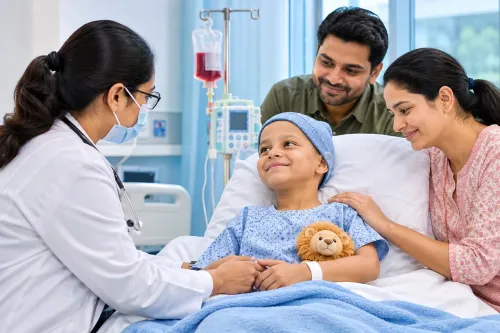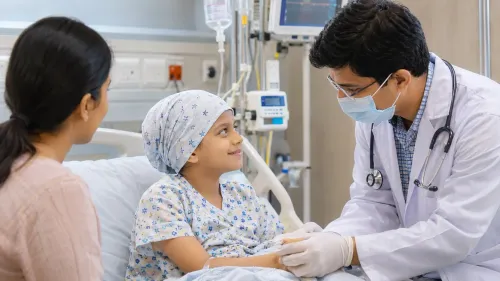

A childhood leukemia diagnosis does not lead to one standard treatment plan. The leukemia’s lineage and genetic findings, the child’s age and initial white-cell count, and the response measured during therapy all influence which medicines, treatment phases, cellular therapies, or transplant options are considered. By the end, you will know what the diagnostic results mean, how treatment is sequenced, and which questions to ask before each major decision.
Key takeaways
- Ask how flow cytometry and genetic testing confirmed your child’s leukemia subtype.
- Expect chemotherapy plans to change according to treatment response and measurable residual disease.
- CAR T-cell therapy and transplant decisions depend on relapse risk, response, and treatment history.
- Keep a written schedule for medicines, blood tests, follow-up, vaccinations, and late-effect screening.
Which type of leukemia does your child have, and how is it confirmed?
A leukemia label is only the starting point. Treatment depends on the cells involved and the genetic changes driving them.
| Type | What it means |
|---|---|
| B-cell ALL | Acute lymphoblastic leukemia arising from immature B cells |
| T-cell ALL | ALL arising from immature T cells; often needs a different protocol |
| AML | Acute myeloid leukemia arising from immature myeloid cells |
| CML | Chronic myeloid leukemia, usually linked to BCR::ABL1 |
| Mixed-phenotype acute leukemia | One leukemia showing both lymphoid and myeloid features |
Doctors begin with a complete blood count (CBC) and peripheral blood smear. A bone marrow aspiration and biopsy then examine the marrow directly. Flow cytometry identifies lineage and abnormal cell markers.
Cytogenetic testing examines chromosomes; fluorescence in situ hybridization (FISH) looks for specific chromosome changes; polymerase chain reaction (PCR) detects known gene fusions or mutations; next-generation sequencing checks many genes at once.
Age, the initial white-cell count, central nervous system or testicular involvement, chromosome changes, gene fusions, and early treatment response place a child into a risk group. That group helps determine treatment intensity.
Measurable residual disease (MRD) means leukemia remains detectable by flow cytometry, PCR, or sequencing below the level visible on routine microscopy. A child can appear well while MRD persists. Detectable MRD at a planned checkpoint raises relapse risk and can lead doctors to intensify treatment or consider cellular therapy or transplantation.
What happens during chemotherapy for ALL and AML?
ALL treatment is deliberately prolonged: remission induction aims to clear visible leukemia, followed by consolidation or intensification to destroy remaining cells, central-nervous-system-directed treatment, and maintenance therapy. Intrathecal chemotherapy goes into spinal fluid through a lumbar puncture even when the fluid is clear, because leukemia cells can hide there.
Cranial radiation is reserved for selected situations because it can cause neurocognitive, endocrine, vascular, and second-cancer late effects.
Maintenance therapy often lasts about two years for girls and three years for boys, but the protocol and risk group set the exact duration. A child who looks well has not necessarily finished treatment; stopping early can leave resistant cells behind.
AML usually follows a shorter, more intensive path: repeated induction and consolidation cycles, with hospital stays and less time overall than ALL. It usually has no long oral-maintenance phase.
A central venous catheter or port delivers chemotherapy, fluids, blood products, and antibiotics, while treatment cycles allow marrow recovery before the next dose. Common problems include:
- Infection risk during neutropenia
- Anemia and low platelets
- Nausea, mouth sores, and hair loss
- Possible fertility effects
Before treatment starts, obtain the centre’s exact fever threshold and after-hours number. Fever during neutropenia is an emergency because bloodstream infection can worsen rapidly, even without obvious symptoms.
When do targeted medicines or CAR T-cell therapy enter the plan?
Targeted treatment enters when testing identifies a drug target or leukemia antigen, or when MRD, relapse, or treatment resistance shows that standard therapy is not enough. Philadelphia chromosome-positive, BCR::ABL1-positive ALL receives chemotherapy plus tyrosine kinase inhibitors such as imatinib or dasatinib.
A deep molecular response can reduce the need for allogeneic transplant in first remission; persistent BCR::ABL1 or MRD can keep transplant under consideration.
- In selected B-cell ALL, blinatumomab targets CD19 and inotuzumab ozogamicin targets CD22. Antigen expression, disease burden, prior therapy, relapse status, and the treatment protocol determine whether either fits.
- AML treatment can include gemtuzumab ozogamicin when CD33 is present, or FLT3- and IDH-directed therapy when molecular testing identifies those mutations.
- CD19-directed CAR T-cell therapy is mainly considered for selected children and young adults with relapsed or refractory B-cell ALL, not as routine first treatment. Eligibility depends on CD19 expression, MRD, relapse or resistance, disease burden, prior therapy, and overall health.
- CAR T-cell treatment requires T-cell collection, manufacturing, and infusion through an experienced cellular-therapy centre. Ask how delays, bridging treatment, and manufacturing failure would be handled.
Cytokine release syndrome can cause fever, low blood pressure, and breathing problems. Immune effector cell-associated neurotoxicity syndrome can cause confusion, seizures, or other neurologic changes, so close monitoring is essential. CD19 treatment can cause prolonged B-cell depletion and low immunoglobulins; plan infection surveillance, blood tests, and replacement immunoglobulin when prescribed.
When is an allogeneic stem-cell transplant worth considering?
Persistent MRD, high-risk genetics, treatment failure, relapse, or a transplant-indicating subtype can shift the balance toward allogeneic HSCT. The decision compares relapse risk against transplant harm; it is not automatic, even in AML or relapsed ALL.
| Option | Main benefit | When it enters |
|---|---|---|
| Continued chemotherapy | Controls disease without donor risks | MRD clears and relapse risk remains acceptable |
| Cellular therapy | Targets leukemia with engineered or donor immune cells | Selected antigen-positive, relapsed or refractory disease |
| Allogeneic HSCT | Replaces marrow and adds a graft-versus-leukemia effect | Persistent MRD, relapse, refractory disease, or high-risk genetics |
HSCT is not simply stronger chemotherapy. Conditioning destroys or suppresses marrow before donor cells are infused; engraftment is the point at which those cells begin producing blood. Your child then needs close monitoring, protective isolation, and prompt treatment for fever and infection.
The work-up includes HLA typing, a matched sibling donor and unrelated-donor search, haploidentical donor assessment, infectious-disease testing, heart, lung, kidney and liver evaluation, fertility counselling, and conditioning planning. Ask which findings make a donor suitable and whether disease control must improve before transplant.
Risks include graft-versus-host disease, serious infection, organ injury, infertility, endocrine or growth problems, chronic graft-versus-host disease, and treatment-related mortality. A paediatric hemato-oncology and transplant team, such as Dr. Atish Bakane, can help interpret MRD, donor findings, and the individual benefit-risk trade-off.
Related services
EXPERTISE Cancer can affect all parts of the body, including the blood. Leukemia and lymphoma are types of blood cancer. View service → |
EXPERTISE Bone marrow transplant (BMT) also called as hematopoietic stem cell transplant (HSCT) is the procedure that is used to replace the unhealthy bone... View service → |
How should families prepare for monitoring, late effects, and clinical trials?
Care continues after the treatment decision through scheduled blood counts, MRD monitoring, medication review, and checks for treatment complications. Keep the centre’s written plan and after-hours number where every caregiver can find them.
- Attend blood-count and MRD or molecular-testing appointments at protocol-defined time points.
- Give every medicine exactly as prescribed; report missed doses rather than doubling the next dose.
- Inspect and protect the central line as instructed, and report redness, drainage, pain, or a loose dressing.
- Track eating, drinking, weight, constipation, vomiting, and mouth sores; ask for a dietitian when intake falls.
- Follow the treating centre’s vaccination schedule. Do not give a vaccine without checking first.
- Seek urgent assessment for fever using the centre’s stated threshold; fever during neutropenia is an emergency.
Survivorship care monitors cardiomyopathy after anthracyclines, endocrine and growth problems, fertility and fertility preservation needs, bone health, neurocognitive and psychosocial effects, chronic graft-versus-host disease, and second cancers. Follow-up depends on cumulative drug doses, radiation, transplant, age, and sex.
| Trial phase | What to ask |
|---|---|
| Phase 1 | Is the dose or safety being tested, and what extra visits are required? |
| Phase 2 | What response is expected, and what tests are added? |
| Phase 3 | What is the control treatment, and does participation change standard care? |
Ask whether the clinical trial compares accepted treatments or aims to reduce toxicity. A trial does not necessarily mean an unproven drug.
Frequently asked questions
How is a child’s leukemia type confirmed?
Doctors use blood and bone marrow tests, including flow cytometry, chromosome analysis, and molecular or genetic testing, to identify the leukemia subtype and changes driving it.
What happens during chemotherapy for ALL and AML?
Treatment uses phases that combine several medicines, with hospital care and monitoring for infection, low blood counts, tumour lysis, and treatment response. ALL and AML use different protocols and schedules.
When are targeted medicines or CAR T-cell therapy considered?
Doctors consider them when the leukemia has a specific molecular target or when disease persists or returns after standard treatment. Eligibility depends on subtype, treatment response, prior therapy, and the child’s condition.
When is an allogeneic stem-cell transplant considered?
A transplant is considered when relapse risk is high, leukemia remains detectable, or the disease returns and the expected benefit outweighs transplant risks. Doctors assess donor matching, remission status, organ health, and infection risk.
How should families prepare for monitoring and late effects?
Keep treatment records and follow-up appointments, ask which blood tests and scans are due, report fever promptly, and use a survivorship plan to monitor learning, growth, fertility, heart health, and other late effects.
Related service
General Appointment ₹500 General Appointment |